The Graphics Processing Unit (GPU) is no longer just for gaming. It has become a powerhouse for all kinds of demanding computing. This change is thanks to its unique design, built for handling many tasks at once.
For technical leaders, architects, and CTOs, using this power through the cloud is a smart strategy — instead of a large upfront cost for hardware, cloud GPUs offer a flexible, pay-as-you-go model.
This article explains how cloud GPUs are essential for modern challenges. We will cover their role in high-end graphics, massive data analysis, and fast AI training.
Why GPU Architecture is Ideal for Demanding Workloads
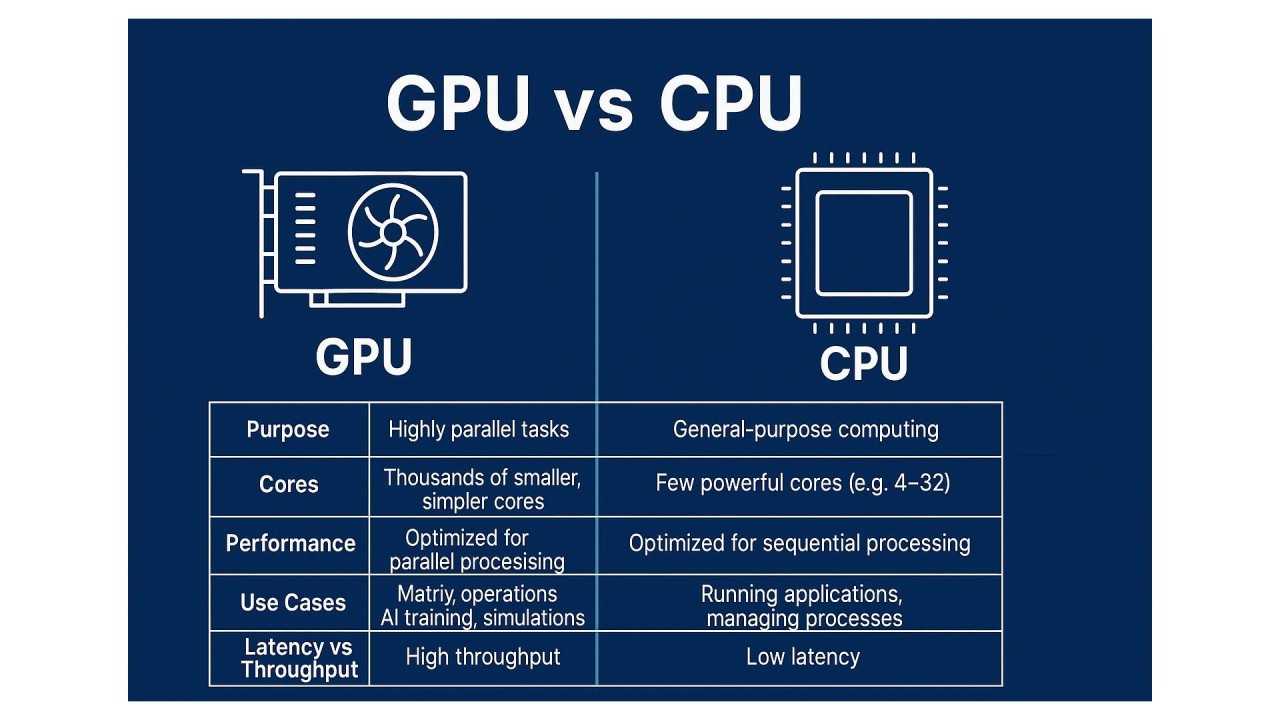
The GPU's power comes from a key difference in its design compared to a Central Processing Unit (CPU).
- A CPU has a few very powerful cores. It's built to handle tasks one after another.
- A GPU has thousands of smaller, simpler cores. It's built to handle many tasks all at the same time.
This makes GPUs perfect for jobs that can be split into millions of identical small calculations. Modern GPUs also have special parts built for specific heavy lifting:
- Tensor Cores: These are made for the complex math behind AI. They make training and running AI models incredibly fast. You can learn more about the specific benefits of GPU for machine learning in our dedicated article.
- Ray Tracing (RT) Cores: These are made for calculating how light moves. They allow for real-time, ultra-realistic graphics in design and simulation.
For businesses, cloud GPUs unlock this top-tier power without the major downsides of owning the hardware. You get access to the most powerful data center GPUs — such as the NVIDIA A100, H100, and L40S — with no large upfront cost or maintenance hassle. This solves major problems like scaling up quickly and avoiding outdated, costly infrastructure.
Use Cases: Strategic Applications for Cloud GPUs
For technical decision-makers, the value of cloud GPUs is realized in their application to specific, high-impact domains. These powerful resources transform key business and technical challenges by providing elastic scalability and cutting-edge performance.
Graphics Rendering and Simulation
Rendering complex 3D visualizations, architectural designs, or VFX is computationally intensive. On-premise render farms require significant CapEx, maintenance, and often create bottlenecks. Cloud-based GPU workstations eliminate the need for costly, depreciating hardware. They deliver:
- Elastic Scalability. Render farms can scale on-demand to meet deadlines, converting fixed costs into pay-per-use OpEx. Discover how a cloud render farm can boost productivity for creative teams.
- High-Performance Access. Global teams can access high-end NVIDIA RTX or professional GPUs from anywhere, enabling remote collaboration.
- Faster Iteration. Parallel processing drastically reduces render times, accelerating creative cycles and improving time-to-market.
Transitioning to the cloud optimizes costs, improves resource utilization, and accelerates project life cycles.
Data Analytics and Scientific Computing
Analyzing terabytes of data for real-time business intelligence, financial modeling, or scientific simulation can overwhelm CPU-based systems. GPUs excel at memory-intensive, parallel processing of large datasets. In the cloud, this means:
- Accelerated Data Pipelines. Process and analyze massive datasets simultaneously, reducing query and simulation times from hours to minutes.
- Practical Complex Modeling. Makes high-fidelity simulations in finance, climate science, and research feasible within practical timeframes.
- Integrated Data Ecosystems: Cloud GPU instances seamlessly integrate with managed data services for a unified analytics platform.
Faster, more granular analysis enables superior, data-driven decision-making and a stronger competitive edge.
Artificial Intelligence and Machine Learning Training
Training modern AI models—from large language models (LLMs) to computer vision systems — requires monumental computational power. The infrastructure cost and expertise for on-premise AI training are often prohibitive. Cloud GPUs are fundamental to AI by providing:
- Parallel Processing for Deep Learning. Tensor Core architecture accelerates the billions of calculations needed for training neural networks.
- Dramatically Reduced Training Time. Reduces training cycles from weeks on CPUs to days or hours, accelerating the innovation pipeline.
- Elastic Experimentation: Enables concurrent provisioning of multiple GPU instances to experiment with model architectures.
Cloud GPUs democratize state-of-the-art AI, allowing organizations to innovate without crippling upfront investment. For a deeper dive into infrastructure, our overview of GPU cloud computing provides further context.
Cloud vs. On-Premise GPU
For Architects and CTOs, the decision between cloud and on-premise GPU resources involves a strategic analysis of Total Cost of Ownership (TCO) and flexibility:
- Cost Model: Cloud GPUs shift costs from CapEx (hardware purchase, data center space, power/cooling) to OpEx (pay-as-you-go). This improves cash flow and eliminates refresh cycle costs.
- Scalability & Risk Management: Cloud resources scale instantly to meet project demands. This mitigates the risks of over-provisioning (wasted capital) or under-provisioning (missed opportunities).
- Access to Latest Technology: Cloud providers continuously update hardware, ensuring access to the latest GPU architectures without the burden of ownership.
- Security and Compliance: Reputable cloud providers offer robust, certified security frameworks and network isolation that can exceed the feasibility of on-premise implementations.
Exploring a cloud hosting GPU solution is the first step to leveraging these advantages.
Conclusion: Strategic Leverage for the Future
Cloud GPU servers are more than raw computing power. They are a strategic tool for business and technology agility. By offering scalable, on-demand processing, they help organizations to accelerate innovation cycles, optimize financial models, mitigate technical risk, and enhance competitive positioning. For technical leaders, the cloud model provides a clear solution. It transforms demanding workloads from an infrastructure problem into a scalable, manageable advantage. To start implementing this strategy, consider the powerful and flexible GPU cloud services available today.